

The New Theatre, Dublin
★★★★☆
During the late 1980s, when the Hong Kong Cantopop singer Anita Mui was bringing her live tour to London, a particular marketing strategy was devised to sell tickets. To make this visitor from faraway seem instantly local and relatable, a rather slack subheading was added to the billing: “Anita Mui: The Madonna of Asia.” It would be a descriptor that’ll follow Mui the rest of her life.
Musically, it was far from true. Madonna chiselled New York dance club beats into a cohesive whole on her self-titled debut (1983), before transitioning into the Nile Rodgers-produced polished pop of Like a Virgin (1984), all with an irrepressible, come-hither desire. Mui’s bag was more familiarly cinematic ballads, on Leap the Stage (1984) and Bad Girl (1985), singing with a voice lower than Madonna’s but similarly full of attitude, and even more agile when required on cover songs, agonising on George Michael’s “Careless Whisper,” longing achingly on The Police’s “Every Breath You Take.”
The comparison says more about the era’s mechanisms of fame for women. Both Mui and Madonna arrived at the same time as women to be reckoned with. There was also a relentless pace to show business that seemed gruelling, as both took advantage of opportunities to transition from pop music to film acting: Madonna in the Susan Sarandon-directed Desperately Seeking (1985), in an alternative version of her tabloid marriage to Sean Penn in Shanghai Surprise (1986), and in the out-of-her-depth screwball Who’s That Girl (1987); Mui in a sequence of decade-defining romantic films – Behind the Yellow Line (1984), Last Song in Paris (1986) and Rouge (1987) – starring alongside the immensely charming Leslie Cheung.
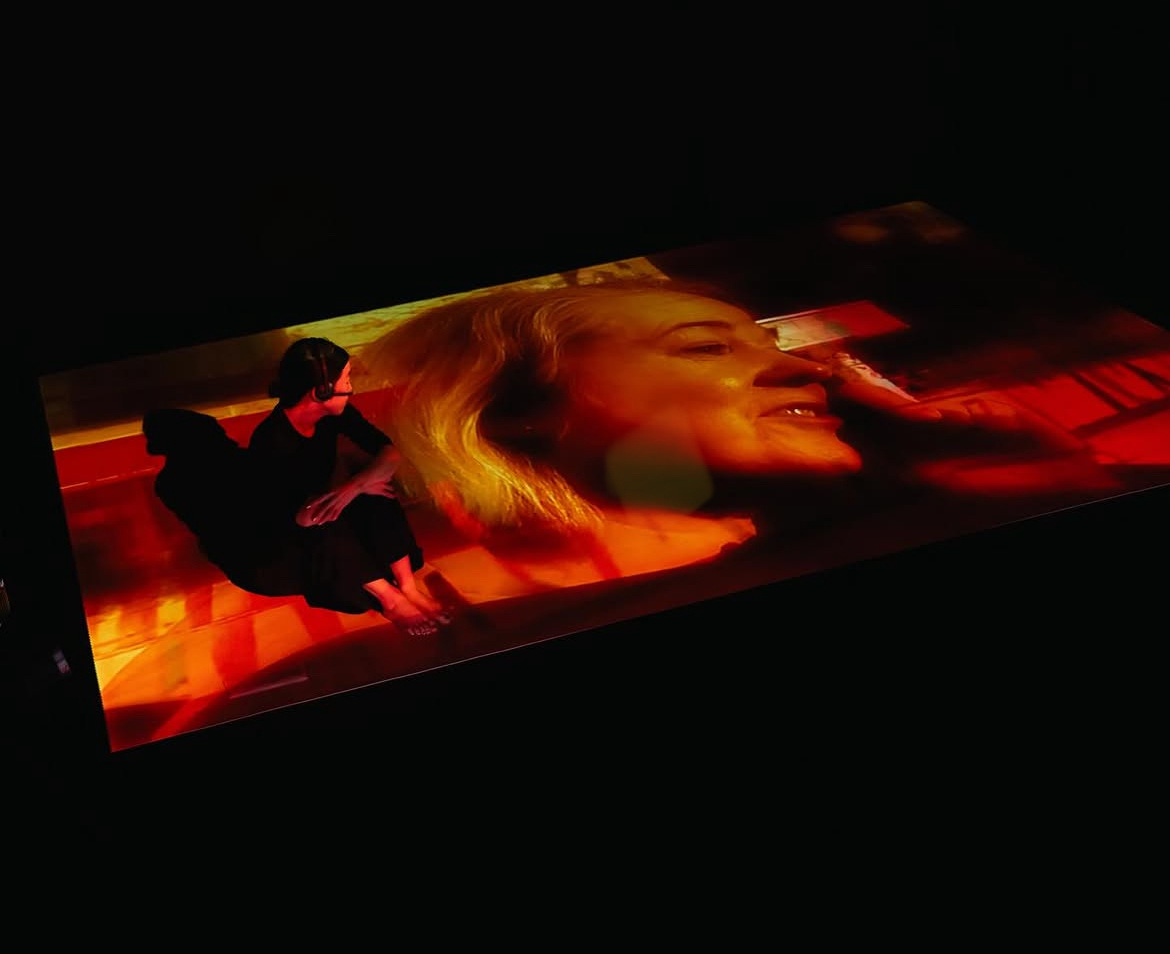
A version of Mui appears in The Madonna of Asia, Choy Ping Ní Chléirigh’s dazzling play for The New Theatre. Our first sight of Rin – played by Mai Ishikawa – isn’t where you expect a former Cantopop-singer-turned-film-actor to turn up. We find her in Dublin, wearing a headset, working as a tech support.
On one customer call, an Irish woman named Tara who lives in Hong Kong (a recorded Clare Barrett, artfully bumbling and excessively polite) tells Rin she finds her name and voice familiar. She had just seen her movie Bright Is the Night, an arthouse Hong Kong film version of Dracula. In Ishikawa’s meticulous, shivering movement, Rin begins to glitch, and slip back into her painful past.
It’s a journey made via the floor projections of Ní Chléirigh’s sublime video design. We see Ishikawa as an anxious, young Rin dropped into the playground of a new school, arrived from Japan to Hong Kong, and acquiring an English name. A bulletin shows a newsreader (Jun-Ling Clarke-Ng) announce that Bright Is the Night, directed by Rin’s husband Lazarus, has won the Palme d’Or award.